


Customer Sucess
We develop more than projects: we help build a more efficient, sustainable country prepared for the future.

Environmental Licensing in Gas Infrastructure: How Raízcon Enabled the Expansion of a Gas Pipeline Network in the State of São Paulo
Raízcon supported an infrastructure company in expanding its gas distribution network across several regions of the state, including a biomethane pipeline connecting the Paulínia landfill to the region’s industrial hub. The project required multiple simultaneous licensing processes, vegetation suppression permits, and interventions in Permanent Preservation Areas (APPs), all without compromising the construction schedule. With an integrated project approach, Raízcon conducted the technical studies and directly advised the client throughout every stage of the process. The result was the rapid issuance of the required authorizations: environmental licenses, vegetation suppression permits (ASV), and approvals for interventions in APPs. What this case demonstrates: in linear infrastructure projects, conducting environmental licensing in parallel with construction is a critical factor for project timelines and feasibility. The difference between months of delays and maintaining the schedule often lies in an integrated approach with strategic vision.

Environmental Due Diligence: How Raízcon Ensured Legal Security in a High-Value Transaction in Santos
Raízcon conducted an environmental due diligence assessment in a strategic port area in Santos/SP, under a tight deadline directly linked to the client’s commercial transaction decision-making process. The scope required a comprehensive assessment of environmental risks and liabilities in accordance with ASTM E1527-21 standards, supported by robust document analysis within a highly restricted timeframe. Using a structured methodology and a multidisciplinary technical team, Raízcon delivered the complete diagnosis within the negotiation deadline. The result: identified environmental concerns and a regulatory liability map with mitigation strategies, providing the client with the legal certainty required to proceed with the transaction. What this case demonstrates: in transactions involving assets in port areas, unidentified environmental liabilities represent a direct financial risk. A well-executed due diligence process is not merely a procedural cost — it is capital protection.
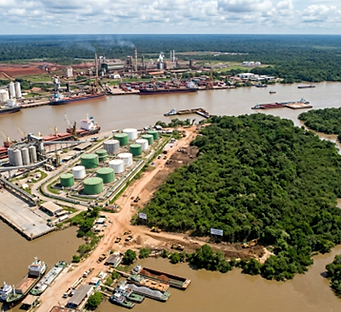
Environmental Feasibility Study: How Raízcon Anticipated Regulatory Risks Before the Licensing Phase for a Chemical Complex in Barcarena
Raízcon carried out an environmental feasibility study for the installation of a large fertilizer chemical complex in the port region of Barcarena/PA. The challenge was to determine whether the site presented any restrictions that could prevent the project before any investment in the regulatory phase, using an integrated diagnosis supported by drone technology and multidisciplinary analysis. Through its methodology, Raízcon mapped critical points of attention — none of which were prohibitive to the project — and anticipated the studies and adjustments required for regulatory compliance in the next phase. The result: the client advanced the project with full clarity regarding environmental requirements, avoiding surprises during the licensing phase. What this case demonstrates: industrial projects in sensitive regions, such as port zones and areas under high regulatory pressure, require environmental diagnostics before licensing — not during it. Identifying critical issues at the right moment is what separates projects that move forward from those that become stalled.

Contaminated Site Remediation: How Raízcon Reduced Soil Disposal Costs by BRL 3 Million in a Former Industrial Area in the Greater São Paulo Region
Raízcon managed the remediation of a contaminated former industrial site in the Greater São Paulo region, with the goal of enabling the land’s redevelopment for residential use. The challenge was to reduce remediation costs without compromising technical safety or regulatory approval by CETESB. With an accurate technical diagnosis and an optimized intervention plan, Raízcon identified the best alternatives for contaminated soil disposal, eliminated unnecessary stages, and accelerated the site closure process with the environmental agency. The result: savings of BRL 3 million in soil disposal costs, a 45% reduction in execution time, and fast approval by CETESB, enabling the safe redevelopment of the site for residential purposes. What this case demonstrates: in contaminated site remediation, the quality of the technical diagnosis directly determines process costs. A well-structured intervention plan is not only a regulatory requirement — it is the primary tool for reducing costs, shortening timelines, and giving clients the confidence to move forward with the project.

Environmental Regularization of a Hotel Development: How Raízcon Enabled Operational Continuity
Raízcon supported the environmental regularization of a large hotel development in São Paulo/SP. The challenge was to bring the operation into compliance with municipal legal requirements while maintaining ongoing activities and implementing the required technical and documentary adjustments. With a structured approach, Raízcon identified non-compliance issues, defined the regularization strategy, and managed the interface with the environmental authority, ensuring that all adjustments were implemented in accordance with legal requirements and without disrupting operations. The result: issuance of the Environmental Operation License, ensuring business continuity and eliminating the risk of sanctions and operational shutdowns. What this case demonstrates: enterprises undergoing environmental regularization require a strategic approach to mitigate operational risks throughout the process.

Environmental Licensing for a Chemical Industry: How Raízcon Conducted the Licensing Process for a Fertilizer Plant
Raízcon conducted the environmental licensing process for the implementation of a fertilizer chemical plant in the countryside of São Paulo. The challenge involved evaluating the project and meeting pollution control requirements in a highly regulated environment. With an integrated approach combining engineering and environmental expertise, Raízcon developed the required technical studies, structuring the process in alignment with the expectations of the environmental agency and anticipating critical issues that could lead to rework or delays. The result was the recognition of the proposed control measures and validation of the project’s locational feasibility, allowing the project to move safely into the next implementation stages. What this case demonstrates: in industrial projects, environmental licensing is not merely a formal step — it is the stage where the project’s business viability is tested. Technical quality and the ability to anticipate risks are essential to avoid regulatory bottlenecks and ensure predictable project development.

Strategic Preliminary Assessment: How Raízcon Reduced Confirmatory Investigation Costs by 46% on an Industrial Site in São Paulo’s East Zone
Raízcon conducted a strategic preliminary assessment of a site with a complex industrial history in the East Zone of São Paulo before its acquisition by the client. The challenge was to identify source areas and hidden liabilities with enough precision to reduce uncertainties, support the acquisition decision, and optimize the following investigation stages under a limited budget, without relying entirely on screening techniques. Using an expanded historical research methodology and integrated multi-source data analysis, Raízcon built a detailed diagnosis of source areas and the site’s documentary history, enabling the Confirmatory Investigation phase to be conducted with a precise scope and without rework. The result: a 46% reduction in Confirmatory Investigation costs, greater predictability regarding site liabilities, and a safer acquisition decision for the client. What this case demonstrates: in transactions involving sites with an industrial history, preliminary assessment is not optional. Investing in diagnosis before acquisition is what prevents financial and regulatory surprises that no contract can reverse afterward.

Analytical Groundwater Monitoring: How Raízcon Demonstrated Remediation Effectiveness and Met Environmental Agency Requirements Across Brazil
Raízcon conducted analytical groundwater monitoring programs across multiple regions of Brazil, meeting environmental agency requirements in different contexts: post-remediation monitoring to demonstrate reductions in contaminant concentrations and continuous monitoring of potential contamination sources in industrial and infrastructure operations. In every case, the challenge was the same: structuring technically rigorous studies capable of meeting all regulatory requirements, securing report approvals, and, in post-remediation cases, technically demonstrating the evolution of contaminant concentrations over time. By developing studies in compliance with current technical standards and aligned with the specific requirements of each environmental authority, Raízcon delivered monitoring programs that were fully approved. In post-remediation cases, analytical results demonstrated proven reductions in groundwater contaminant concentrations, technically supporting the advancement to subsequent site closure stages. The result: monitoring programs approved by environmental agencies across all projects, with technical confirmation of contaminant reduction in post-remediation cases and ongoing compliance with operational conditions required for industrial and infrastructure activities. What this case demonstrates: analytical groundwater monitoring only fulfills its purpose when structured with technical precision from the outset. Reports that fail to meet regulatory requirements generate rework, delays, and additional costs. The quality of the technical study determines whether the process advances or becomes stalled during regulatory review.

Environmental Study Based on IFC Standards: How Raízcon Conducted an Environmental Assessment for One of Brazil’s Largest Data Center Complexes in the Southern Region
Raízcon conducted a regional environmental assessment to support the installation decision for one of the country’s largest data center investments, located in southern Brazil. The study was structured according to IFC Performance Standards, meeting the requirements of the project’s international investors and anticipating the needs of the regulatory phase. The challenge was to assess an area spanning hundreds of hectares with high hydrological complexity, characteristic of southern Brazil, while identifying all relevant environmental restrictions for the project: erosion processes, indigenous communities, mining polygons, protected heritage sites, cultural assets, and other constraints that could impact project feasibility or layout. Through detailed surveys and mapping of water resources and environmental constraints, Raízcon developed an integrated environmental restriction map that supported engineering design decisions and enabled preventive adjustments before the regulatory phase. The result: the study enabled investor decision-making supported by IFC standards, provided the project team with the environmental information necessary to guide development, and generated a diagnosis that anticipated licensing requirements, reducing the risk of regulatory surprises in subsequent stages. What this case demonstrates: large-scale projects backed by international investors operate under environmental due diligence standards that go beyond Brazilian regulatory requirements. Environmental diagnostics must be robust enough to support design decisions, anticipate licensing requirements, and protect investments from risks that only become visible when it is too late to correct them.

Environmental, Health, and Safety Due Diligence: How Raízcon Identified Non-Conformities and Risks in an Agroindustrial Operation in Piauí
Raízcon conducted an Environmental, Health, and Safety Due Diligence assessment for a 2,000-hectare agroindustrial asset in Piauí focused on seed processing. The study was based on ASTM E1528-14 and ASTM E1527-21 standards and aimed to identify environmental, health, and safety risks and liabilities that could impact the ongoing commercial transaction. Using a multidisciplinary approach, in-depth document analysis, and field inspections in a remote and difficult-to-access location, Raízcon mapped the site’s current and historical conditions. Relevant non-conformities and a potentially impactful neighboring activity were identified, including the risk of groundwater contamination affecting the property. The study outlined the necessary corrective actions and responsibilities to be addressed before closing the transaction. The result: technically supported decision-making, full visibility of the asset’s risks, and elimination of uncertainties that could compromise the transaction value or generate unforeseen liabilities after acquisition. What this case demonstrates: in acquisitions of large agroindustrial assets, environmental due diligence is the tool that separates a safe acquisition from inheriting liabilities. Identifying risks before closing gives buyers negotiation leverage and financial protection after the contract is signed.
Follow Raízcon on Social Media

